1
You Prepare the Robot
Attach clean pads, add approved cleaning solution if required, connect power and set up the model's safety rope, station or other physical backup according to its instructions.
 Michael
• Updated on: Aug 03, 2026
Michael
• Updated on: Aug 03, 2026
Window cleaning robots use suction to stay attached to glass, motors or drive systems to move across the pane, sensors and software to plan a cleaning path, and pads plus controlled spray to loosen and wipe away dirt. Safety systems add backup power, edge detection and physical fall protection.
Affiliate disclosure: As an Amazon Associate I earn from qualifying purchases. SmartRobotReviews may also earn commissions from other retailer links, at no extra cost to you.
A window robot creates enough negative pressure to hold itself against compatible glass. Once attached, it moves in a planned pattern while microfiber pads or cleaning surfaces contact the pane. Many current models spray cleaning fluid automatically. Sensors help detect edges, obstacles and movement conditions, while software determines where the robot should travel next.
The important point is that suction, navigation, cleaning and safety are separate systems working together. A large advertised suction number alone does not tell you whether a robot will clean well or be convenient to use.
Attach clean pads, add approved cleaning solution if required, connect power and set up the model's safety rope, station or other physical backup according to its instructions.
An internal fan generates negative pressure between the robot and glass. This adhesion lets the machine remain attached while its drive system moves.
The robot monitors movement, boundaries and operating conditions. More advanced systems combine multiple sensor types with navigation software.
Instead of moving randomly, current robots generally use systematic path planning designed to cover the pane efficiently and return to a useful finishing point.
Controlled spray moistens the cleaning path while microfiber pads or specialized cleaning surfaces wipe the glass. Exact mechanisms differ by model.
Current window robots generally cannot transfer themselves between separate windows. When one pane is finished, the user repositions the robot.
| System | What It Does | Why It Matters |
|---|---|---|
| Microfiber / cleaning pads | Stay in contact with the pane while the robot travels | Provide the physical wiping action that lifts loosened dirt |
| Automatic spray | Applies controlled moisture or approved solution | Helps loosen grime without requiring constant manual spraying |
| Multiple spray outlets | Distribute liquid across the cleaning path | Can improve coverage; current products use designs ranging from triple spray to four-spray systems |
| Specialized scraping / sweeping | Adds another mechanical cleaning stage | HOBOT SP10, for example, is listed with a spray-sweep-scrape approach |
| Route overlap | Controls how cleaning paths intersect | Good navigation and wiping mechanics need to work together for consistent results |
Not necessarily. Suction primarily keeps the robot attached and contributes to stable movement/contact. Cleaning quality also depends on pad design, moisture control, route planning, pressure distribution, dirt type and whether the pads are clean.
This is why comparing a 6000Pa claim with a 6500Pa claim is not enough to choose a window robot. SRR treats suction as one component of the system rather than a standalone performance score.
Reputable systems use several protection layers because no single safeguard should carry the entire job.
The fan maintains suction while the robot works. Some systems monitor pressure and compensate when attachment conditions change.
Sensors help detect boundaries and abnormal movement, particularly where there is no frame.
Backup batteries can keep a robot attached temporarily if mains power is interrupted, giving the user time to recover it.
Safety ropes, tethers or station anchoring provide another layer if the robot loses adhesion. Always install these exactly as the manufacturer specifies.
Current premium robots monitor multiple operating conditions and can issue alerts when something is wrong.
The final safety layer is correct use. A sophisticated protection system cannot compensate for ignoring the manufacturer's surface, weather, power or tether requirements.
You normally reposition the machine pane by pane. This is the biggest difference from a robot vacuum that can navigate an entire floor by itself.
Dirty pads can smear glass. Pads still need cleaning, replacement or rotation depending on the system and size of the job.
Heavy mineral deposits, paint, adhesives and other stubborn contamination may require manual treatment or specialized cleaning.
Framed versus frameless glass, pane dimensions, seals, obstacles and indoor/outdoor conditions can affect compatibility. Always check the exact model.
These products illustrate different engineering approaches; this is not a replacement for SRR's ranked Best Window Cleaning Robots page.

Shows the premium approach: multifunction station, Win-SLAM 5.0 navigation, triple spray and 12-level protection.
Check Price on Amazon →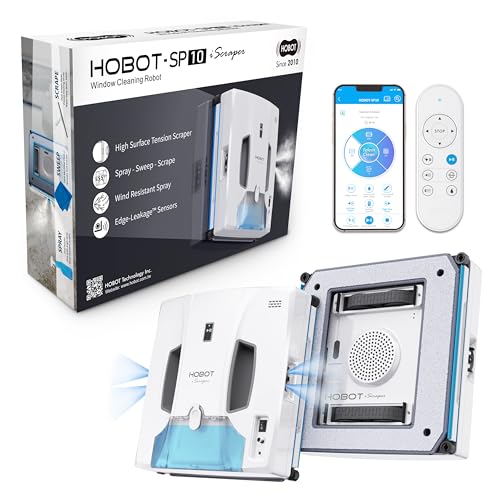
Demonstrates a different cleaning mechanism with spray-sweep-scrape operation and explicit framed/frameless positioning.
Check Price on Amazon →
Shows the standalone value approach with four water sprays, laser sensor detection and a 6000Pa claimed suction specification.
Check Price on Amazon →An internal fan creates negative pressure between the robot and the glass. The resulting suction holds the machine against the pane while it moves.
Most current models rely on continuous external power while operating. Backup batteries are generally a safety feature intended to maintain attachment temporarily during a power interruption, not the main cleaning power source.
Robots use sensors and navigation logic to detect boundaries and control movement. The exact system varies by model, and frameless glass places greater importance on reliable edge detection.
Many current models do. Designs vary from triple-nozzle systems to four-spray and ultrasonic spray approaches. Always use the liquid or cleaning solution specified by the manufacturer.
Some can, but compatibility is model-specific. For example, HOBOT SP10's verified listing explicitly includes framed and frameless glass. Check the manufacturer's requirements before use.
No. They automate movement and cleaning on an individual pane, but users still typically prepare the robot, secure its safety system, move it between windows and maintain the pads.
1 month
1.7M
7 years, 8 months
398K
7 years, 9 months
202K
8 years, 5 months
87.9K
5 years, 3 months
87.8K
4 years, 3 months
65.3K