
Do Robot Lawn Mowers Work Under Trees?
Yes, but trees are one of the hardest environments for wire-free robot mowers. Dense canopy can weaken satellite reception, while trunks, roots, shade and narrow passages make the job harder physically too.
If your yard has a lot of tree cover, prioritize LiDAR or strong multi-sensor navigation over a simple acreage rating. RTK can work under lighter canopy, but dense tree cover is where backup sensing matters most.
Trees do not automatically rule out a wire-free mower
A few isolated trees in an open lawn are usually much easier than a yard with dense canopy, buildings and narrow side passages.
The more your yard blocks the sky, the more useful LiDAR or strong vision backup becomes.
Why Trees Are Difficult for Robot Mowers
Blocked satellite view
Leaves and branches can weaken or reflect GNSS signals, especially when a house, wall or fence also limits sky view.
Reflected signals
Signals can bounce off nearby structures and vegetation before reaching the mower, making positioning less stable.
Roots and uneven ground
Even perfect navigation cannot stop a wheel from struggling on a large exposed root or sharp change in ground level.
Seasonal change
A route that works in spring can become harder when summer foliage closes the canopy.
How Difficult Is Your Tree Cover?
Lower difficulty
- One or two isolated trees
- Open sky between branches
- Wide lawn around trunks
- Few nearby walls or buildings
- Only short periods of canopy blockage
Higher difficulty
- Dense mature canopy
- Trees close to the house
- Narrow side yards
- Overlapping tree crowns
- Long corridors with little visible sky
Current Robot Mowers That Make Sense Under Trees
The older page discussed the navigation problem correctly, but the market now has stronger LiDAR and multi-sensor options that deserve to be called out directly.

Segway Navimow i215 LiDAR
i215 LiDAR is one of the most useful current examples for tree-heavy lawns because it combines LiDAR and vision instead of depending only on satellite positioning.
Best for: lawns up to about 0.37 acre with trees, walls or buildings that reduce sky visibility.
🛒 Check Amazon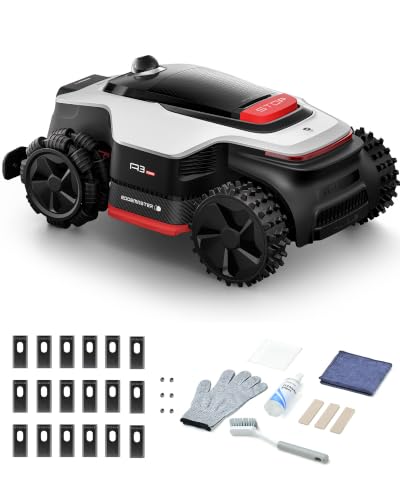
Dreame A3 AWD 2000
Dreame's 360° 3D LiDAR and dual AI vision approach is attractive when tree cover and uneven ground appear together.
Best for: medium lawns up to about 0.5 acre where both navigation and traction matter.
🛒 Check Amazon
MOVA LiDAX Ultra 3000 AWD
This is an important current option that the old page did not include. It combines 360° 3D LiDAR, dual AI vision and AWD without requiring RTK.
Best for: tree-heavy lawns up to about 0.75 acre where blocked sky is a major concern.
🛒 Check Amazon
Roborock RockMow X130H
RockMow takes a different route: full-band RTK plus quad-vision navigation and 4WD. It is worth considering when you still have enough sky for RTK but want stronger visual backup around trees and structures.
Best for: larger mixed-visibility lawns up to about one acre.
🛒 Check Amazon
Mammotion LUBA 3 AWD 3000
LUBA 3 combines LiDAR, NetRTK and AI vision, making it a strong fit when a property alternates between open lawn and tree-heavy sections.
Best for: larger hilly multi-zone lawns where both navigation redundancy and AWD matter.
🛒 Check AmazonWhat About Tree Trunks and Exposed Roots?
A mower can know exactly where it is and still struggle physically around a tree. Large roots can lift the chassis, reduce traction or leave strips of grass the deck cannot safely reach.
Use supported no-go zones or exclusion areas rather than relying only on obstacle detection to avoid contact with bark or exposed irrigation.
If roots and slopes are the bigger issue than satellite reception, see AWD vs 2WD Robot Lawn Mowers.
Shade Can Change the Mowing Schedule Too
Grass under trees often grows more slowly because of shade and competition for moisture. That means a shaded zone may need less mowing than the open lawn.
If your mower supports zone-by-zone scheduling, use it rather than forcing every area to run on the same timetable. See How Often Should You Run a Robot Lawn Mower?.
Who Should Buy a Wire-Free Mower for a Tree-Heavy Yard?
Good candidate
- Tree cover is intermittent rather than continuous
- The mower has LiDAR or strong vision backup
- Passages are wide enough for reliable travel
- Roots can be excluded where necessary
- You can map difficult zones separately
Be cautious if...
- The property feels more like a wooded lot than a lawn
- Most zones have very little visible sky
- Long passages run between trees and buildings
- Large roots cover much of the mowable area
- You are choosing by acreage alone
Bottom Line
Robot lawn mowers can work under trees, but dense canopy is a navigation stress test.
For difficult tree cover, look first at navigation redundancy—LiDAR, vision or a strong hybrid system—then check roots, narrow passages and traction. Do not choose by acreage alone.
Frequently Asked Questions
Does RTK work under trees?
Is LiDAR better than GPS under trees?
Will a robot mower hit tree trunks?
Can a robot mower go over tree roots?
Does AWD solve mowing under trees?
Which current mower is best suited to tree-heavy lawns?
Start With These 3 Main Lawn Mower Pages
More Robot Lawn Mower Guides
You May Also Like
SmartRobotReviews may earn a commission from qualifying purchases. Product details, pricing and availability can change.