
Can Robot Lawn Mowers Cross Driveways and Paths?
Yes—many current robot lawn mowers can cross a private driveway, sidewalk or garden path when the surface is reasonably flat and the route can be mapped safely.
The difficult cases are not usually smooth concrete. They are raised edges, loose gravel, steep transitions, narrow passages and routes used by cars or the public.
A flat private crossing is usually easy
If the driveway is level, the lawn meets it almost flush, and the mower supports mapped connections between zones, crossing can be straightforward.
Think of the driveway as a travel corridor, not a mowing area.
Which Driveway and Path Surfaces Work Best?
| Surface | Typical fit | Main issue | What to check |
|---|---|---|---|
| Smooth concrete | Good | Usually little traction difficulty | Edge height and route safety |
| Asphalt | Good | Uneven edges, heat | Flush transition to grass |
| Pavers | Good if level | Joints and uneven blocks | Continuous wheel path |
| Compacted fine gravel | Depends on mower | Wheel slip and loose stones | Traction and stone depth |
| Loose or deep gravel | Poorer fit | Spinning, sinking, displaced stones | Prefer another route |
| Stepping stones | Variable | Gaps and level changes | Continuous support under wheels |
| Raised curb | Often unsuitable | Vertical step | Do not assume AWD solves it |
The Edge Is Often Harder Than the Driveway
Flush edge
This is the ideal case. The mower can roll on and off the hard surface without a meaningful step.
Raised lip
A curb or edging strip can stop a mower even when the driveway itself is perfectly smooth.
Drainage channel
A depression, slot or grate can catch smaller wheels or change the approach angle.
Loose edge material
Loose gravel at the lawn edge can become the weak point even if the center of the driveway is firm.
Can One Robot Mower Cross Between Front and Back Lawns?
Yes. This is one of the most useful features of modern wire-free systems. If two grass areas are separated by a private driveway or path, supported mowers can often connect them with a mapped passage or travel route.
The app may call this a channel, path, link, passage or connection, depending on the brand.
If you are still choosing a mower for a multi-zone property, start with the Best Robot Lawn Mowers guide.
Do Wire-Free Mowers Handle Crossings Better?
They are usually easier to configure because virtual maps can connect disconnected grass zones without physically laying a boundary wire through the route.
If traction is the real issue, see AWD vs 2WD Robot Lawn Mowers.
Current Mowers That Make Sense for Multi-Zone Crossings
You do not need AWD just to cross smooth concrete, but these current models are useful examples when a property combines disconnected zones with slopes, uneven transitions or more difficult routing.
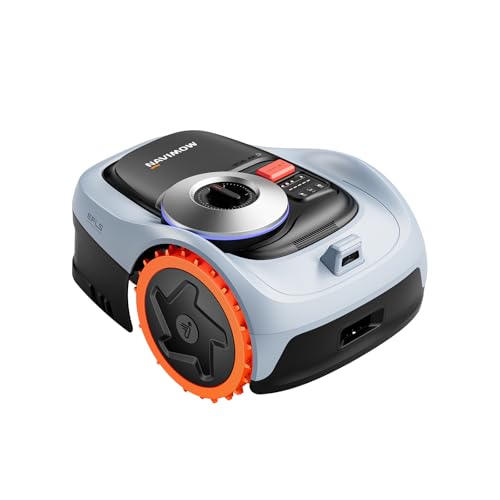
Segway Navimow i206 AWD
Useful when a small property has disconnected lawns plus slopes or rough transitions. AWD is the reason to consider it—not the driveway itself.
Who should buy it: small multi-zone yards where traction matters.
🛒 Check Amazon
Dreame A3 AWD Pro 2500
A strong fit when the crossing itself is easy but surrounding terrain, trees or complex zone geometry make LiDAR-led mapping and 4WD useful.
Who should buy it: medium multi-zone yards with difficult terrain.
🛒 Check Amazon
Roborock RockMow X115H
This was missing from the older page. It combines 4WD with full-band RTK and quad-vision navigation for up to about 0.37 acre.
Who should buy it: smaller complex yards where traction and multi-sensor navigation both matter.
🛒 Check Amazon
MOVA LiDAX Ultra 3000 AWD
Another current option missing from the older article. It uses 360° 3D LiDAR, dual AI vision and AWD for up to about 0.75 acre.
Who should buy it: larger multi-zone lawns where RTK-free mapping and strong traction are both appealing.
🛒 Check AmazonShould a Robot Mower Cross a Driveway Used by Cars?
A private driveway you can control is very different from a shared access road, public sidewalk or route with frequent vehicle traffic.
The mower sits low to the ground and can be difficult to see from some vehicles. Keep automated routes within areas where you have permission and can maintain safe operation.
What About Gravel?
Compacted fine gravel
A short, firm crossing may be workable for some mowers if the stones are small and the wheels stay on top of the surface.
Loose or deep gravel
Much less predictable. Wheels can spin, dig in or move stones, and the chassis can drag on uneven material.
Who Should Prioritize Multi-Zone Crossing?
Prioritize it if...
- Your front and back lawns are disconnected
- A private driveway divides two grass zones
- You have side-yard mowing areas
- You want one mower to service the whole property
- You need editable virtual travel routes
Do not force a crossing if...
- Cars frequently use the route
- The mower would enter a public street
- There is a tall curb
- The gravel is deep or unstable
- The route contains stairs or large drainage gaps
Bottom Line
Yes, many robot lawn mowers can cross driveways and paths. A flat private hard-surface route with flush edges is the easiest case.
Choose the mower based on both navigation and physical mobility: mapping tells the robot where to go; traction and chassis design determine whether it can actually get there.
Frequently Asked Questions
Can a robot lawn mower cross a concrete driveway?
Can a robot mower cross gravel?
Can a robot mower travel from the front yard to the back yard?
Does AWD make driveway crossing easier?
Can a robot lawn mower climb a curb?
Can a robot mower cross a public sidewalk?
Start With These 3 Main Lawn Mower Pages
More Robot Lawn Mower Guides
You May Also Like
SmartRobotReviews may earn a commission from qualifying purchases. Product details, pricing and availability can change.